The invention of the printing press spread terror. The world was clearly about to be flooded with printed “slop” rather than authentic, hand-copied manuscripts. Perhaps these dreaded machines would even steal the jobs of scribes, town criers and monks?

In fact, printed books turned out to be a rather handy invention (Jeffrey Archer novels excepted). Gatekeepers like the Church no longer monopolised information, new industries sprang up, and the Enlightenment occurred.
Could it be that the same thing is happening again with AI?
Where better to find out than a place sharing its name with that thing you do with books: Reading?
Last week’s #Reading100AI ran over thirty sessions, and the expert speakers explored the myriad ways in which The AI Revolution is transforming human communication.
A working version of the Gutenberg Press was even in attendance to emphasise that AI is a step change as historic as the invention of publishing, and that my opening metaphor was blatantly nicked from them.
Sessions covered everything from James Bond films to football to molecular design, with the marriage of AI enhancement and human judgment the unifying theme.
Events were kicked off by the enviably named Dr Jumbly Grindrod, an eminent philosopher who argued persuasively that chatbots are not pale imitations of humans, but technologies in their own right. They should neither be dismissed as “autocomplete on steroids” nor confided in like anthropomorphic chums, but are extraordinary resources that may well embody human culture more fully than anything else currently in existence.
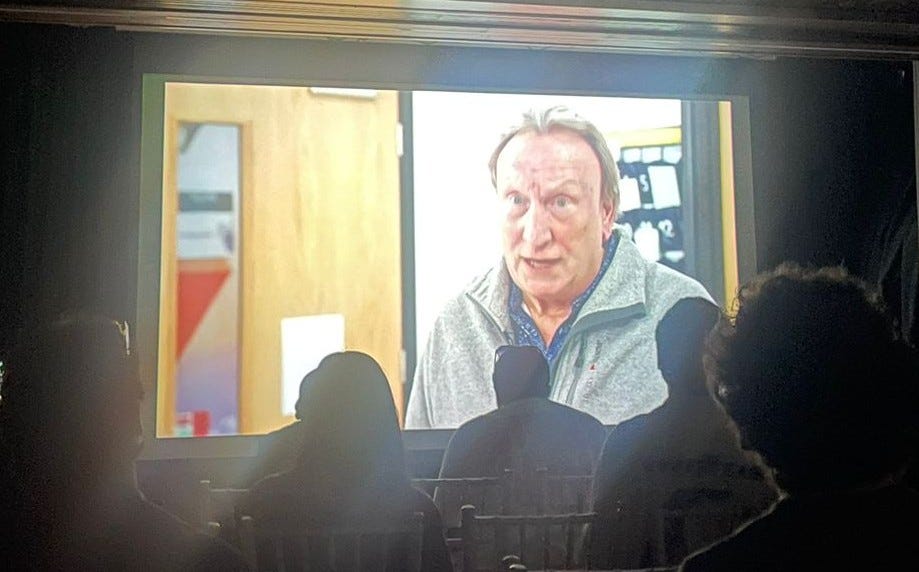
Dominic Lees is not only Reading’s Associate Professor in Filmmaking and Head of the Synthetic Media Research Network, he is a former director of the legendary TV drama “This Life”.
Dominic argued that generative AI filmmaking is a distinctive art in its own right, and should stand alongside traditional cinema. However, given that by next year, we won’t easily be able to tell what is AI-generated and what is not, it is important that we maintain trust, and that is best done with regulation. Without it, deception and manipulation may be increasingly difficult to detect.
Dominic’s entertainingly broad-ranging session also revealed the incredible variety of ways in which AI tools are enabling groundbreaking films to be made; how face-swap technology enabled David France’s Welcome to Chechnya to safely conceal the identities of its activist interviewees; how the makers of National Geographics’s Endurance documentary trained AI voice conversion tools with 1910 wax phonograph cylinders; how Steven Soderbergh used generative AI in John Lennon: The Last Interview to visualise some of Lennon’s more abstract ideas; how Val Kilmer is starring posthumously in As Deep As The Grave after his family authorised his regeneration with AI; and even how Kenyan-Swiss sci-fi mockumentary Memory of Princess Mumbi used AI in a plot centred on the challenges of making a film without AI. Mindbogglingly meta in the non-Zuckerberg sense, but also rather intriguing.
There was some superb practical, hands-on training with Sam Chaher of Thames Valley AI Hub (TVAI), who walked us through how to use replit to build an app; how to use an LLM to help secure the credentials required to upload it to the App Store or Play Store, and how to secure the data from the actions of capricious, orange-haired Americans.
With the cost of tokens soon expected to take off like one of Elon Mush’s more functional SpaceX rockets, Lamboss supremo Rick Berends’ talk on maximising their efficient use was timely. Breaking everything down into bitesized chunks, asking for answers that are concise and precise, and finishing every conversation before starting a new topic were all excellent tips for avoiding blocked pipelines (a problem not confined to plumbing). Giving the smallest possible inputs also works wonders made sense: PDFs, tables, diagrams and even Word documents all contain unnecessary gubbins that can be stripped out or condensed, particularly with the help of classifiers and sites like ASCII Art.
Stuart Fenton, Head of Artificial Intelligence at Reading Football Club, revealed how AI tools were helping the League One locals to overcome some of the financial disparities in the game by transforming player scouting, and reducing the costs of behind-the-scenes operations. An AI animation for fans had proved controversial, but also topped the viewer engagement list.
Art director Tim Browning’s credits include Project Hail Mary, Star Wars, and a hat-trick of Bond movies, and he gave an absorbing insight into the strengths and limitations of AI-generated concept art, the challenges of light saber selection, and how James Bond’s death scene inadvertantly included a smiley face emoji in the set design.
The hugely enjoyable event was expertly organised by Neil Linford-Relph , Sam Chaher, and NVIDIA AI‘s Ross Verrall, who gave a comprehensive overview of agentic AI in his keynote speech.
The Edinburgh TV Festival may offer an exquisitely expensive opportunity to witness smug staffers fiddle while the traditional media industry burns, but this was an infinitely more relevant free alternative full of visionary speakers, practical advice and boundless enthusiasm.
I came away inspired by the almost infinite potential of humanity to partner with AI, create previously impossible thngs, solve seemingly intractible problems, and communicate more effectively.
Shaggy Dog AI is split between London and Reading, and this event was one of many reminders that theThames Valley is at least as dynamic as the Big Smoke.