One of the literary world’s most wildly imaginative geniuses compared himself to a large language model. Italo Calvino, the greatest Italian author of the twentieth century, wrote: “It is with a clear conscience and without regrets that I state that my place could perfectly well be occupied by a mechanical device.”1
Calvino’s feverishly innovative novels included Invisible Cities, The Castle of Crossed Destinies, and If on a winter’s night a traveler, all of which chucked metaphorical custard pies at the conventions of linear narrative, and celebrated the intricacies of storytelling with a playful genius that won him the Legion of Honour, and made him the most translated author in the Italian language. His fame soon transcended literature, and he was made jury president of the Venice Film Festival.
However, for this colossus of creativity, human authorship was simply a matter of pattern recognition:
“Writers, as they have always been up to now, are already writing machines; or at least they are when things are going well. What Romantic terminology called genius or talent or inspiration or intuition is nothing other than finding the right road empirically.”2
Calvino’s descriptions of his own writing sound uncannily similar to predictive text: “Literature as I knew it was a constant series of attempts to make one word stay put after another by following certain definite rules.”3
Tell that to the legions of stroppy, self-righteous refuseniks condeming any AI deployment as a taint on the blessed purity of literature!
Then upset them even more by revealing that Calvino and his writing group (OuLiPo) once attempted to make a computer-generated novel.4
Now that they are really riled, point out that Calvino was not some cynical hack hoping to churn out “slop” for a quick buck. This was an author Gore Vidal described as “the only great writer of my time.”5 and of whom Salman Rushdie, winner of The Booker of Bookers, wrote:
“It is entirely possible that Calvino is not a human being at all, but a planet, something like the planet Solaris of Stanislaw Lem’s great novel. Solaris, like Calvino, possesses the power of seeing into the deepest recesses of human minds and then bringing their dreams to life. Reading Calvino, you’re constantly assailed by the notion that he is writing down what you have always known, except that you’ve never thought of it before. This is highly unnerving: fortunately, you’re usually too busy laughing to go mad.”6
Yet today’s literary establishment, and its armies of holier-than-thou “authenticity puritans” would doubtless cancel Calvino out of existence for daring to suggest that creativity could be mechanised.
Literary snobbery is a common affliction, and rarely is it more evident than in attitudes towards creative collaborations with AI.
Like those “wretched” LLMs, all humans authors “scrape” the cultures they inhabit for inspiration, stealing willy-nilly from every interface. And however heavily writers are burdened by what Harold Bloom called the “anxiety of influence”, their compositions will still follow patterns long-established by their predecessors, much in the manner of a large language model.
This is how crazily inventive and prescient Calvino’s novels could be:
If on a winter’s night a traveler (1979)
-
A supposed printer’s error makes every even-numbered chapter the beginning of a different novel following the tropes of its own genre.
-
That printer’s error may be the result of a conspiracy to destroy fiction.
-
The reader is turned into a character, plonked into the narrative in every odd-numbered chapter, and given a recurring love story.
-
Reading the book is uncannily close to an LLM undergoing training; you process cultural fragments with distinct codes of their own, and the narrative ony exists through the process of your interaction with them.
-
Reality is expressed as something written beyond human control. One day, Calvino predicts, humanity will realise it makes just as much sense to say “it writes” as “it rains”. It even turns Descartes on his head with the line: “The universe will express itself as long as somebody will be able to say, ‘I read, therefore it writes'”.
The Castle of Crossed Destinies (1973)
-
A bunch of travelers tell each other stories.
-
But they have all lost the power of speech.
-
They can only communicate via Tarot cards.
-
Somehow, it not only makes sense, they tell tales combining elements from the greatest stories ever told.
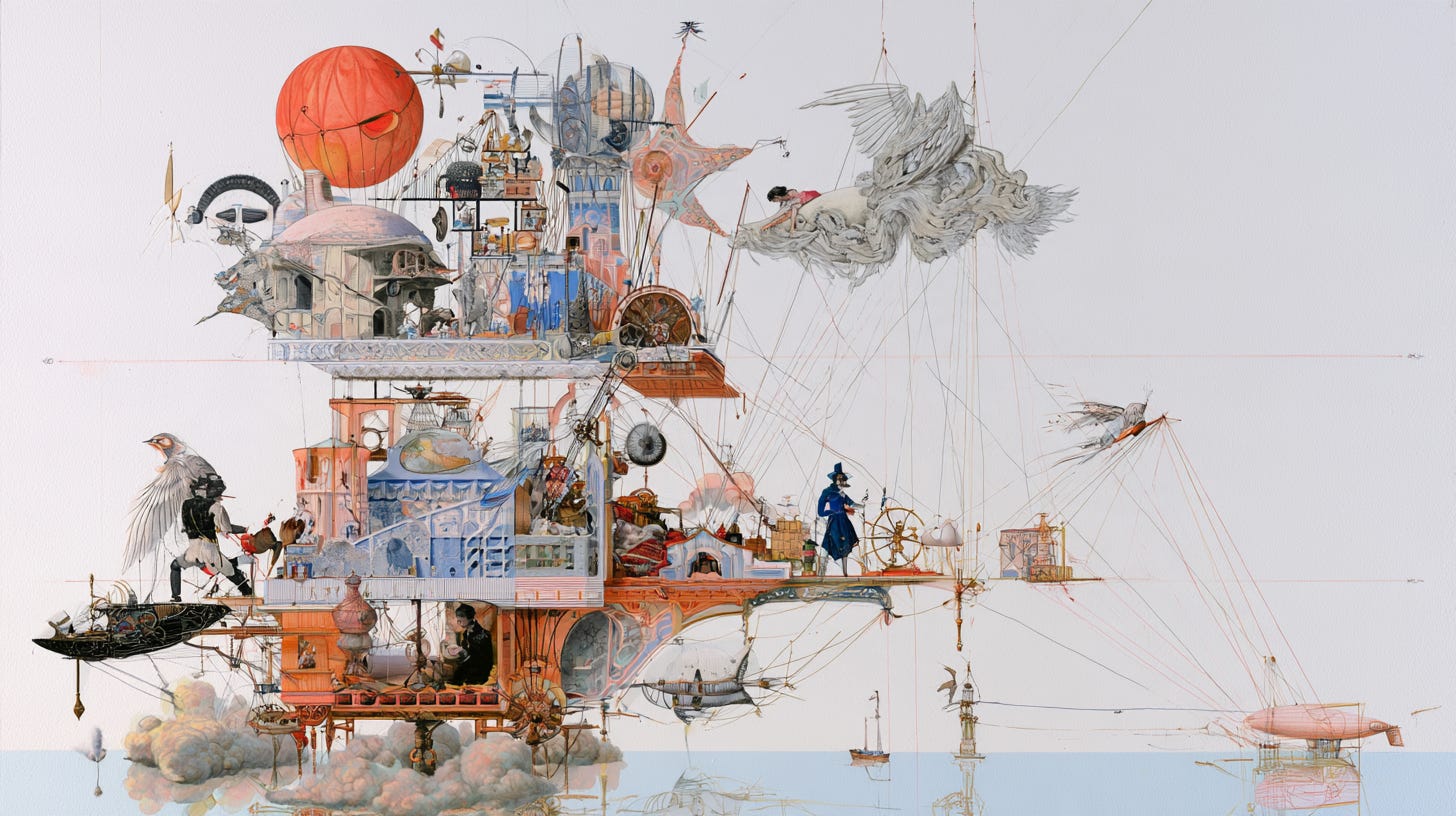
Invisible Cities (1972)
-
The book describes 55 imaginary cities with a poetic beauty so sublime, it makes the fantasy novels of George R.R, Martin and JRR Tolkien seem as pedestrian as The Stockport Evening Adverizer.
-
It is structured like a polyhedron, so it is more like a 3D shape than a flat, linear narrative, with the cities divided into eleven thematic groups across nine chapters.
-
The whole caboodle is framed as a chat between the explorer Marco Polo and the Emperor Kublai Khan.
-
Spoiler alert. Somehow, the 55 cities turn out to be the same place.
So, Calvino may have believed that he could be replaced by a machine and that a book’s literary genious lies more in how it is read than how it is written, but he was clearly an insanely creative genius. That would not have stopped him being condemned by today’s pitchfork-wielding, anti-AI mob.
People have been banging on about the death of the author, the mathematics of mythology and structures of meaning for decades, but Calvino’s vision was far more prophetic than that.
Way back in 1967, Calvino was alive to the notion that large language models might open the floodgates of creative innovation:
“I am not now thinking of a machine capable merely of “assembly-line” literary production, which would already be mechanical in itself. I am thinking of a writing machine that would bring to the page all those things that we are accustomed to consider as the most jealously guarded attributes of our psychological life, of our daily experience, our unpredictable changes of mood and inner elations, despairs and moments of illumination.”7
His prediction was that, whilst these writing machines might begin by trotting out tropes, they would eventually rebel against these confines.
“Nothing prevents us from foreseeing a literature-machine that at a certain point feels unsatisfied with its own traditionalism and starts to propose new ways of writing, turning its own codes completely upside down.”8
The machines, Calvino believed, would turn from slavish conformity to delishly inventive anarchy:
“The true literature machine will be one that itself feels the need to produce disorder, as a reaction against its preceding production of order: a machine that will produce avant-garde work to free its circuits when they are choked by too long a production of classicism.”9
To me, AI collaboration does not kill creativity, and it is not necessarily “cheating”. Some venerable academics have even advocated “distant writing”. Luciano Floridi has described the process of using large language models to produce text, with the human taking on the role of “designer”.10
Maybe this will become a new genre of its own – and, with reading plummeting in popularity, perhaps the infinite possibilities opened up by this kind of cyber-collaboration can reignite interest in literature.
I wrote this article without AI assistance, partly for the bants and partly because I enjoy “close” (human-authored) writing. All of the video content I make Shaggy Dog AI with Emma Reynolds is human-authored and human-directed, but AI tools allow us to bring our visions and those of our clients to life.
AI film is establishing itself as a groundbreaking new genre, and there is no reason why distant writing and other forms of AI-human collaboration in literature cannot too.
I put it through Substack’s AI detector and it said it was 100% human written. Perhaps I have some way to go before I become one of Calvino’s “writing machines”.
Calvino is definitely worth a read. His 1967 lecture is available for free HERE. And his best-loved novels, unlike this article, are short!
I am indebted to the excellent “AI-generated literature, distant writing and the reader: Reflections on Floridi and Calvino” by W. J. T. Mollema, which can be read for free HERE.
Cybernetics and Ghosts, lecture delivered in Turin and other Italian cities, November 1967, available in: Calvino, Italo. (1986). The Uses of Literature. San Diego, New York, London. Harcourt Brace & Company pp. 3 to 27. Available for free HERE.
Cybernetics and Ghosts, lecture delivered in Turin and other Italian cities, November 1967, available in: Calvino, Italo. (1986). The Uses of Literature. San Diego, New York, London. Harcourt Brace & Company pp. 3 to 27. Available for free HERE.
Cybernetics and Ghosts, lecture delivered in Turin and other Italian cities, November 1967, available in: Calvino, Italo. (1986). The Uses of Literature. San Diego, New York, London. Harcourt Brace & Company pp. 3 to 27. Available for free HERE.
Lima, E. (2023b). Le città invisibili as Cybertext and Cyberspace: Italo Calvino, Ted Nelson, and Arata Isozaki. Italian Studies, 78(2): 192-209. https://doi.org/10.1080/00751634.2023.2220538.
Interview with Riz Khan. https://www.reddit.com/r/TrueLit/comments/e7zgrx/gore_vidals_moving_interview_on_italo_calvino_2011/
https://www.lrb.co.uk/the-paper/v03/n17/salman-rushdie/calvino
Cybernetics and Ghosts, lecture delivered in Turin and other Italian cities, November 1967, available in: Calvino, Italo. (1986). The Uses of Literature. San Diego, New York, London. Harcourt Brace & Company pp. 3 to 27. Available for free HERE.
Cybernetics and Ghosts, lecture delivered in Turin and other Italian cities, November 1967, available in: Calvino, Italo. (1986). The Uses of Literature. San Diego, New York, London. Harcourt Brace & Company pp. 3 to 27. Available for free HERE.
Cybernetics and Ghosts, lecture delivered in Turin and other Italian cities, November 1967, available in: Calvino, Italo. (1986). The Uses of Literature. San Diego, New York, London. Harcourt Brace & Company pp. 3 to 27. Available for free HERE.
Floridi, L. (2025a). Distant Writing: Literary Production in the Age of Artificial Intelligence. Minds and Machines 35: 30. https://doi.org/10.1007/s11023-025-09732-1.